Chase Sapphire Preferred Review
From my Medium archive: the CSP's 25% redemption boost (the 2022-era rule; Chase moved to Points Boost in 2025), the value math against its $95 fee, and my own mileage after a year and a half with the card.


Where the card stands in August 2026: the current welcome offer is 75,000 points after $5,000 of spend in the first 3 months, the annual fee is still $95, and a mid-2026 refresh added 3x on gas, EV charging, and vacation rentals plus a $120 Global Entry or TSA PreCheck credit and a $100 annual Chase Travel hotel credit. A limited-time 100,000-point offer ended July 30, 2026.
This review comes from my Medium archive, originally published in July 2022. Offers, rates, and benefit values reflect that time, so verify current terms before applying. A 2026 update follows at the end.
The Chase Sapphire Preferred, or CSP, is a travel rewards card that can make sense even without its signup bonus. The signup bonus was the easy part of the case when I first reviewed it.
The highlights at the time:
- 60,000 bonus points on $4,000 of spend in the first 3 months, worth $750 with the 2022 travel redemption bonus
- 5x on travel booked through Chase Ultimate Rewards, roughly 6.25% back after that boost
- 3x on dining and eligible delivery services, roughly 3.75% back after that boost
- $95 annual fee
The Chase Ecosystem
The card's defining feature in 2022 was what it did to Chase points. Redeeming through Ultimate Rewards for travel got a 25% bonus on the value of every point, and that boost applied to points earned elsewhere in the Chase system. Points accumulated on a no-fee card like the Freedom Flex became worth more once a Sapphire sat in the same account.
Valuing Ultimate Rewards conservatively at 1 cent per point, the 60,000-point signup bonus was $600. The 25% travel redemption boost brought it to $750. Third-party point valuations often ran higher, but I prefer using a lower value unless I already know the exact redemption.
Earning Rates
Travel booked through the Chase portal earned 5x, which the 2022 redemption boost turned into roughly 6.25% back. Travel booked outside the portal earned 2x, closer to 2.5% after the boost, which was fine but not the reason to hold this card.
Dining and eligible delivery services earned 3x, about 3.75% after the boost. Online groceries and select streaming services earned 3x as well.
The Extras
Beyond the earning rates, the card carried $50 in annual statement credits for hotel stays booked through Ultimate Rewards, no foreign transaction fees, Pay Yourself Back categories that redeemed points at the boosted rate against selected purchases, a complimentary year of DashPass, and rotating partnerships like Lyft and GoPuff at the time.
Each account anniversary also awarded bonus points equal to 10% of the prior year's purchases, so $10,000 of spend returned an extra 1,000 points.
The Value Math
Is it worth the $95 fee? Using the assumptions in my 2022 review, millennials were estimated to spend about $4,400 a year on vacations, which at 6.25% was about $275 back. The average US household spent $2,375 on dining and takeout, another $89 at 3.75%.
Add one subscription partnership, with DashPass roughly valued at $120 a year, and the $50 hotel credit, and the baseline landed around $534 of annual value against a $95 fee. That was before counting Pay Yourself Back, the anniversary bonus, or the signup bonus itself. With the $750 bonus, the first year penciled out around $1,284.
My own mileage at the time: $190 in fees across a year and a half, against roughly $1,350 in accrued value including the signup bonus, plus extras like a free year of Instacart+. The same annual-fee math I apply to every card in my wallet had no trouble clearing the bar here.
The Verdict
Public ratings were strong when I originally reviewed the card: 4.5 stars across thousands of Chase reviews, 5 stars from NerdWallet's editors, and 4.5 from The Points Guy. For travel-focused users already in or entering the Chase ecosystem, the CSP comfortably earned its fee in my 2022 math.
Approval odds are generally strongest for applicants with good to excellent credit. If you're earlier in that journey, building strong credit first is the better sequence.
2026 Update: How It Actually Played Out
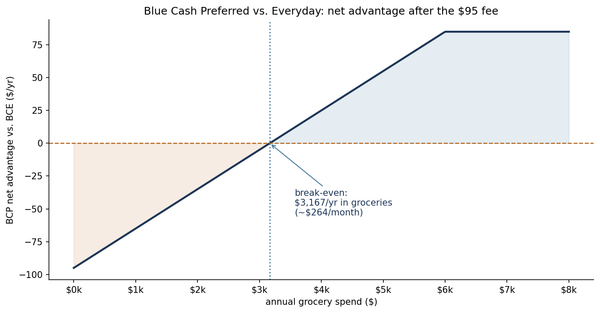
I held the CSP from December 2020 to January 2024, and then did the same thing I eventually do with most annual-fee cards: reran the fee math and product-changed it to a no-fee Freedom card, keeping the account age and the $21,100 credit line while dropping the $95 fee. It's the same arc as my Blue Cash Preferred downgrade, and it says nothing bad about the card, only that my travel booking habits shifted away from the Chase portal over time.
The redemption that best captures the card's value while I had it: 28,704 points cashed in for $358.80 of travel in late 2021. That's exactly 1.25 cents per point, the boosted redemption rate this review was built around.
The card itself has changed since. Chase overhauled the Sapphire lineup in 2025, and the flat 25% redemption boost has been giving way to variable Points Boost pricing on selected bookings, with transition rules for existing cardholders. The welcome offer also moves around. The broad shape of the card is intact, but treat the 2022 numbers above as history and check current terms.
One more piece of the story that belongs here: by the time I downgraded, my travel spend was being fully consumed by the Amex Platinum, so the CSP's travel multipliers had nothing left to earn on. What I do miss is the ability to redeem Ultimate Rewards points as airline transfers. Cashback is simple, but transfer partners were the one lever where a Chase point could be worth meaningfully more than a cent, and no cashback card replaces that.