The Upside of Homeownership
How cash flow, equity, and leveraged appreciation can tilt the equation towards buying

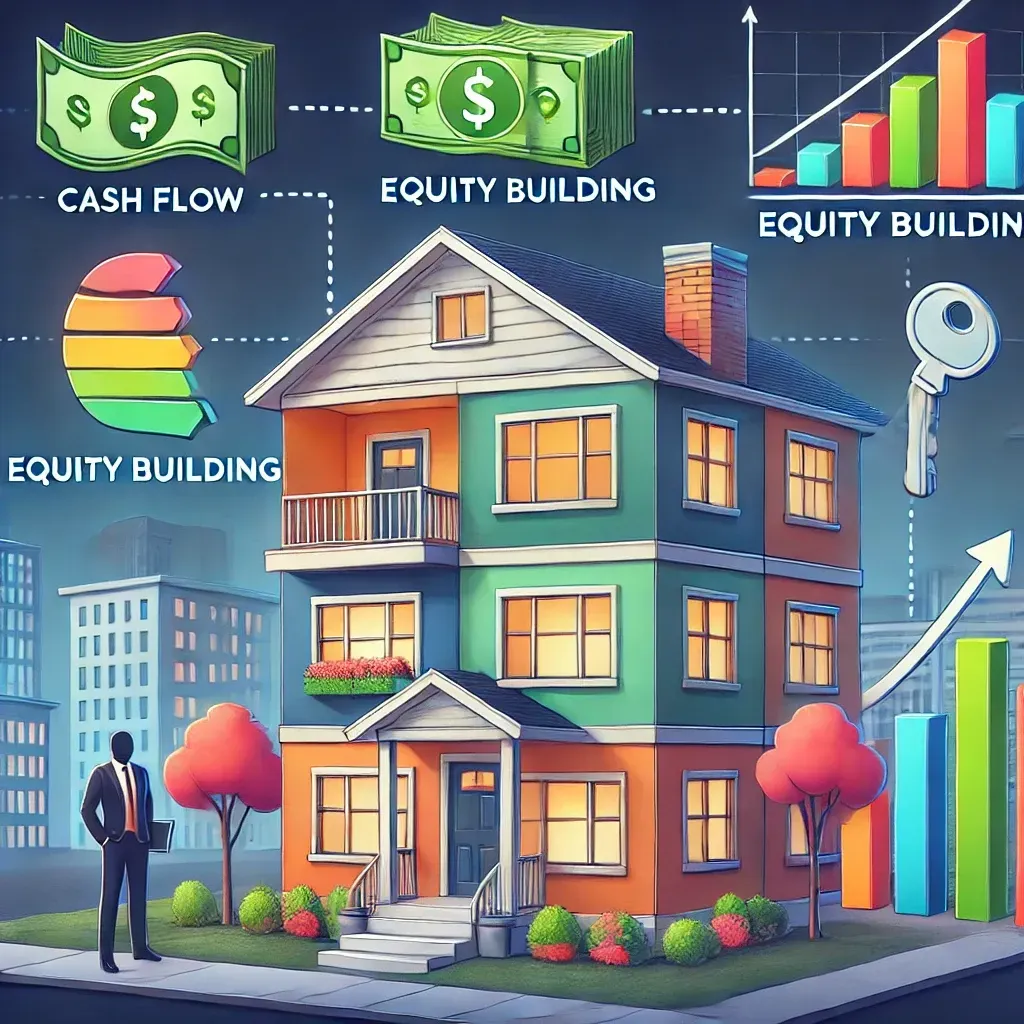
Homeownership, especially through a strategy like house-hacking a multifamily property, has a real financial upside. That upside breaks down into three angles: cash flow, equity building, and leveraged appreciation. Understanding each one helps in evaluating both the cash flow and net worth implications of a given property, and the range of options that opens up.
Cash Flow: Rental Income as a Financial Boost
The biggest upside of house-hacking a multifamily property is letting rental income offset living expenses. Living in one unit while renting the others can reduce or even eliminate the monthly housing cost.
When rental income exceeds the mortgage, taxes, insurance, and maintenance combined, the result is positive cash flow. If the mortgage runs $3,000 a month and tenants contribute $2,500 in rent, the effective cost of living there drops to $500 a month. Even without reaching positive cash flow, rental income can still meaningfully reduce the monthly cost, which matters especially in expensive areas. I'm currently aiming to match my rent for a shared two-bed, one-bath at around $1,200 a month, while being willing to pay up to $800 more than that.
Equity: Building Wealth With Each Payment
Homeownership builds equity over time, functioning as a kind of forced savings plan. Every mortgage payment reduces the principal balance and increases ownership in the property.
The trade-off is geographic risk: job and home both become tied to the fortunes of the same region rather than being independent of each other. Every dollar that goes toward principal is effectively a dollar saved, and it compounds as the loan gets paid down. That process is slower for me right now, since I'm looking at loan products like a 5/1 ARM with 5% down over 40 years, which carry higher interest rates in exchange for cash flow that actually works. As equity builds, it can also be put to use later, whether through refinancing to access cash or as leverage for a future investment.
On a $400,000 property with a 5% down payment, or $20,000, paying down the mortgage over five years builds modest equity even before any appreciation is factored in.
Leveraged Appreciation: Magnifying Returns With Debt
This is the angle I find most compelling. Real estate is one of the few assets where meaningful leverage is standard practice. With 5% down, the investment is levered 20 times, so a 5% annual appreciation on the property turns into roughly a 100% return on the initial investment before costs. Boston appreciated about 4% over the past year, which on that same leverage works out to an 80% return, a solid outcome. A 20% down payment cuts the leverage to 5 times, which is less risky but produces a smaller return on the same appreciation.
On a $500,000 multifamily property, 5% down means a $25,000 initial investment. If the property appreciates 5% a year, that's $25,000 in appreciation, which roughly doubles the initial investment in a single year. With 20% down, the initial investment rises to $100,000, and the same $25,000 in annual appreciation now represents a much smaller share of the money put in.
Leverage magnifies losses just as easily as gains, so if the property value drops, the same math runs in reverse. That's how loans end up underwater, which is both a financially draining position and a difficult one to get out of.
The Multifamily Advantage: Combining All Three Angles
House-hacking a multifamily property lets all three benefits stack in a single investment: rental income reduces or eliminates monthly housing costs, equity builds with every payment, and leveraged appreciation amplifies the return on any price growth. That combination is what makes multifamily properties appealing: living for less while building wealth through several channels at once.
There's still an opportunity cost worth accounting for, though: the return that capital could have earned elsewhere, and the time spent navigating the challenges of renting and owning property, either of which can tilt the calculation the other way.
The Takeaway
Homeownership is a place to live, but through house-hacking it can also function as a strategic investment that improves cash flow, builds net worth, and adds long-term financial security. Combining rental income, equity building, and leveraged appreciation is what makes the multifamily version of this so compelling. The trade-offs, mainly leverage risk and maintenance costs, are real and shouldn't get waved away, and the details of financing this kind of purchase are covered in more depth in the FHA loan breakdown for multifamily properties and in the house-hacking case itself. For me, the potential to grow net worth while cutting housing costs still makes homeownership worth exploring.