GenCast: DeepMind’s Next Frontier in Weather Prediction
Can AI predict chaos? DeepMind’s GenCast is rewriting the rules of weather forecasting, promising life-saving precision and long-term impacts on how we navigate extreme conditions.

GenCast is a weather forecasting model from Google DeepMind, published in the journal Nature in December 2024. Instead of simulating the physics of the atmosphere the way traditional forecasting systems do, it learned the behavior of weather from roughly four decades of historical data. The result is a probabilistic 15-day forecast that beat the best physics-based system on most of the measures that matter.
Why Weather Is Hard
Weather is the textbook example of a chaotic system. Tiny differences in starting conditions grow into completely different outcomes within days, which is the butterfly effect in its original habitat (the term comes from meteorology, not pop science). Since we can never measure the atmosphere's starting state perfectly, a single forecast is guaranteed to drift from reality as the days go on.
Forecasters deal with this by running ensembles: many simulations from slightly perturbed starting points, read together as a distribution of possible futures rather than one answer. If that sounds familiar, it is the same idea as Monte Carlo simulation. When a system is too tangled to predict exactly, sample it many times and plan against the spread.
The catch is cost. Traditional ensembles simulate atmospheric physics on supercomputers with tens of thousands of processors, and each run takes hours. That limits how many ensemble members you can afford and how often you can rerun them.
What GenCast Does Differently
GenCast is a diffusion model, the same family of machine learning that powers image generators, adapted to generate plausible future states of the atmosphere instead of pictures. DeepMind trained it on about 40 years of historical weather reanalysis data, and it produces a 50-member ensemble forecast out to 15 days in around 8 minutes on a single TPU chip.
Speed would not matter if the forecasts were worse, but they were not. In the published evaluation, GenCast beat the ensemble system of the European Centre for Medium-Range Weather Forecasts, widely treated as the world benchmark, on 97% of the targets tested. DeepMind has been here before with AlphaFold, which did something similar to protein structure prediction, so the pattern of learning a hard scientific problem from data is becoming something of a house specialty.
Where It Matters
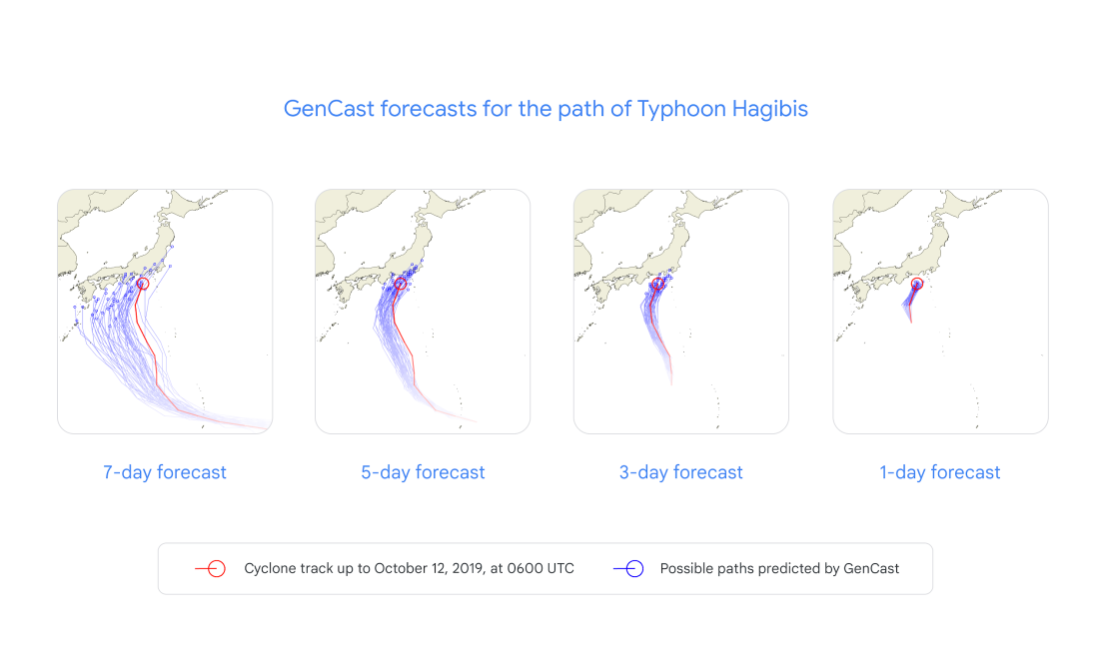
The headline gains are on extreme events: tropical cyclone tracks, unusual heat and cold, and high winds. These are exactly the forecasts where extra accuracy converts directly into time to prepare, whether that means evacuating ahead of a hurricane or protecting crops ahead of a frost.
The quieter benefits compound over time. Insurers price weather risk, farmers schedule planting and irrigation around rain, and grid operators plan around wind output. Small improvements in forecast quality feed into each of those decisions daily, which adds up in the way small edges usually do.
The Takeaway
The interesting part is not a better weather app. It is the evidence that learning a chaotic system from its history can outperform simulating it from first principles, at a small fraction of the computing cost.
It is tempting to extend that thought straight to financial markets, and I would resist the easy version of it. Weather does not respond to being predicted, while markets do: the atmosphere follows physics, but other traders adapt to whatever edge you find. So I read GenCast less as a stock-picking omen and more as one more argument for thinking in distributions: when the future is chaotic, the useful output is not a prediction but a well-built spread of possibilities.